Where do we go from here? Identifying the leading causes of food insecurity and helping where we can.
Take a moment to stop and think of all the reasons a family might not have consistent access to food. It’s a wide range of factors, such as insufficient household income, needing to spend money of bills, healthcare expenses, an unstable economy, urban versus rural communities, and lack of transportation. And as we saw through the realities of the pandemic, a family can be “fine” until schools are locked down and one or more family members lose their jobs.
Hunger is the result of an under-resourced household. The same factors that limit food access also make it harder for food insecure households to find the right resources to stabilize their families and succeed. This is where our 12 network member food banks, their 2,400 partner agencies, and our healthcare partners come into play.
Individuals experiencing hunger often must make difficult decisions due to lack of sufficient funds or a sudden decrease in household income. These tough spending choices are the reality of being able to afford both food and other expenses. When the COVID-19 pandemic hit, our network saw an increase in weekly meals missed in 66 of our 67 Florida counties. This was largely due to the fact that so many Floridians were experiencing recent unemployment. A sudden change in a family’s financial situation can lead to a challenging cycle of food insecurity and limit access to healthy and consistent food options.
What you can do: If you are involved with a non-profit, church or school, consider becoming a registered Feeding Florida food pantry. Thanks to over 2,400 partner agencies, like these food pantries, we are able to provide millions of meals to Floridians each year.
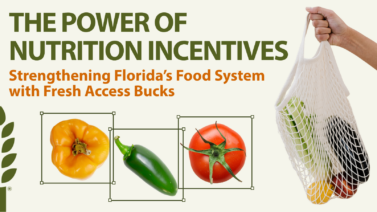
Spending tradeoffs leave food insecure individuals with impossible choices. When a mother must choose between aftercare for her children or fresh food, she will have to make a difficult sacrifice for the sake of her family. We believe everyone should have affordable access to fresh produce and foods in order to provide for their family’s needs. Each of our 12 network member food banks offer year-round food distributions to provide support to families experiencing a difficult season of life, no matter when that is. Our Fresh Access Bucks (FAB) program also increases the purchasing power of SNAP recipients to buy fresh fruits and vegetables at farmers markets, produce stands, CSAs, mobile markets, and community grocery outlets.
What you can do: If you work with any local markets or produce stands in your area, you can contact our FAB team to see if your market qualifies as a Fresh Access Bucks outlet. By doing this you help our network increase food access and affordability to fresh produce so food insecure individuals don’t have to make impossible spending tradeoffs in order to afford food.
Chronic illnesses and health concerns are often remedied with costly medications and treatments. Floridians who are experiencing hunger at the same time as a health concern often can’t be expected to shoulder the heavy cost of both, even though they are necessary for overall health and wellbeing. Therefore, our FoodRx and Mobile Farmacies were developed with the help of our healthcare partners so more Floridians don’t have to choose between treating their illness or treating their hunger.
Sometimes the reason an individual can’t access fresh food and produce is simply because they can’t get to a grocery store or farmer’s market. Lack of transportation leaves people reliant on food delivery services or whatever food is closest to them, which isn’t always the most nutritious option. Whether the person is disabled, cannot drive, homebound, or lacks the resources for transportation, Feeding Florida’s network is dedicated to bringing the necessary food and produce to them. Our home delivery programs and mobile markets allow for individuals to access fresh foods without having to travel.
What you can do: Volunteer with your local food bank or food pantry to deliver meals to individuals who lack transportation access to grocery stores, farmer’s markets, etc. By delivering food to individuals experiencing hunger, you are helping to increase food access and provide for a neighbor in need.
While we can’t guarantee that an individual will not experience hunger or lack of food access at some point in their life, we can guarantee that no matter the circumstances, our Feeding Florida network will be dedicated to help. With over 3 million hungry Floridians, it’s a lofty goal- but it’s ours. We will help put food on every table that needs us.